
 Luke Pensworth
Frontier Internet, the internet part of Frontier Communications, has succeeded in filling a major service gap left by many cable internet and DSL internet providers (ISPs): rural areas where dial-up and satellite internet are otherwise the only options.
As the 4th-largest DSL provider, they cover an impressive 38 states with not only DSL coverage, but some fiber-optic service as well. In the course of that, they advertise a wide range of internet speeds, with their fiber plans offering the most impressive of the bunch.
But is Frontier internet really bad? We don't think so. How many of their (many) plans are available near you - especially if you live in the boonies? Is Frontier Internet the answer to your high-speed-internet prayers, or leave you paying more for the same service you could get with satellite internet?
Let’s find out!
Frontier Internet Plans and Prices
For all types of plans, prices start out O.K., but climb down the road – we’ll discuss that in depth later.
Let’s get one thing out of the way right away: Frontier advertises a lot of plans – 13, to be exact, not counting the bundles we’ll talk about later. The thing is, like with many internet providers, not all of those plans (and their corresponding speeds) will be available to you – you’ll get to see a limited selection, depending on your location.
Even so, we’re going to cover them all here. We’ll break it up by their 2 service types: DSL and fiber-optic.
Frontier DSL plans
| Plan | Speeds | Price | View plans |
|---|---|---|---|
| Simply Broadband Core | 6Mbps | $20/mo. | View plans |
| Simply Broadband Ultra | 12Mbps | $25/mo. | View plans |
| Simply Broadband Plus | 18Mbps | $30/mo. | View plans |
| Simply Broadband Elite | 25Mbps | $35.mo. | View plans |
| Simply Broadband Power | 45Mbps | $40/mo. | View plans |
| Simply Broadband Performance | 70Mbps | $45/mo. | View plans |
| Simply Broadband Extreme | 90Mbps | $50/mo. | View plans |
| Simply Broadband Velocity | 115Mbps | $60/mo. | View plans |
| Vantage Internet Simply Elite | 25Mbps | $30/mo. | View plans |
| Vantage Internet Simply Power | 45Mpbs | $35/mo. | View plans |
Frontier’s DSL plans range from as few as 6Mbps all the way up to 115Mbps (but no 100Mbps). In the middle of the road, your price is pretty comparable to other major DSL players - for example, AT&T Internet has a 50Mbps plan for $50 a month plus an up front fee, while Frontier’s Broadband Elite gives you 45Mbps for $10 bucks cheaper a month (and just $9.99 up front).
Frontier’s DSL plans are also more available than their fiber ones – but subsequently, there’s a much lower cap on your internet speed. Even so, DSL is still much faster than satellite internet in most cases, and cable won’t typically be an option in a rural region, making their speeds (in the 100, 200, 300, and higher range), a moot point.
Frontier FiOS plans
| Plan | Speed (Download/Upload) | Price | View plans |
|---|---|---|---|
| Simply FiOS 50/50 | 50/50Mbps | $29.99/mo.* | View plans |
| Simply FiOS 200/200 | 200/200Mbps | $39.99/mo.* | View plans |
| Simply FiOS 300/300 | 300/300Mbps | $99.99/mo.* | View plans |
| Simply FiOS 500/500 | 500/500Mbps | $150/mo.* | View plans |
| Simply FiOS 1G/1G | 1000/1000Mbps | $200/mo. | View plans |
*With 2-year agreement.
Frontier FiOS fiber internet plans aren’t nearly as available as their DSL plans, but speeds are pretty good. And initially, the first 2 plans give you as-fast or faster internet speeds than comparably-priced DSL plans - great! If they’re the only option in your area for fiber, sign up.
But when you hit the 300, 500, and 1000Mbps (1Gbps) range, prices skyrocket. For reference, AT&T offers their fiber internet plans for much cheaper: just $50 a month for 300/300 and just $70 a month for their 1Gbps-equivalent.
That said, if Frontier FiOS internet service is in your neighborhood, it’s worth checking out.
ZERO data caps
Unless you’re a super-using data fanatic, you probably don’t need to worry about internet data caps. Most companies provide big ones that are effectively unlimited for the typical user (1TB, or 1,000GB). But if you’re concerned, don’t be: Frontier internet doesn’t have a data cap.
And also, even if they did, it’s not like you would lose internet access for going over it – ISPs don’t really do that anymore. Your internet would just be slowed down for the rest of the month. With Frontier, you have zero cause for concern there. No data cap means no data cap. Really.
Bundles
| Plan | Bundling type | Price | View plans |
|---|---|---|---|
| Simply FiOS 50/50 + Phone Unlimited | (Fiber) Double Play | $51/mo.* | View bundles |
| Simply Broadband Elite + Phone Essentials | (DSL) Double Play | $51/mo.* | View bundles |
From what we could find, Frontier mainly deals in double-play bundles: Internet + landline Phone service. But that said, if you need TV service - and cable isn’t available - Frontier bundles with DISH Network. So, you could build your own triple-play that way - and combine everything into one bill.
Frontier Internet Contracts, Fees, and Equipment
There are no contracts with Frontier Internet DSL plans - awesome. Plus, you get a price-lock for the first 12 months; in some cases, for 24 months.
Plus, they’re running a promotion: the “Price for Life”. Although it’s only applicable to the lowest-tier internet offering, Simply Broadband Core, that $20 bucks a month is locked in for as long as you stay a customer.
Plus, as with any promotional offers, if you cancel your service before its terms are up, it’s like cancelling a contract and you’ll face early termination fees.
Even if you don’t, you’ll pay $9.99 to be disconnected.
FiOS contract
BUT, if you want one of Frontier’s FiOS plans, you’ll be required to sign a 2-year contract. Fortunately, if you do so and decide you want out before it’s done – it’s just $100 bucks max to do so. That’s better than other ISPs, who typically charge upwards of $200 or $300 on the high end.
Fees + Equipment charges
A downside to all of Frontier’s plans, whether DSL or FiOS, is that the advertised prices don’t included taxes and fees. Luckily, there’s only a few, and most are one-time:
- $10 Wi-fi router rental, or $150 to buy theirs;
- Installation fee of $40 or $75 (depending);
- Self-install fee: $9.99.
Frontier Internet Availability + Performance
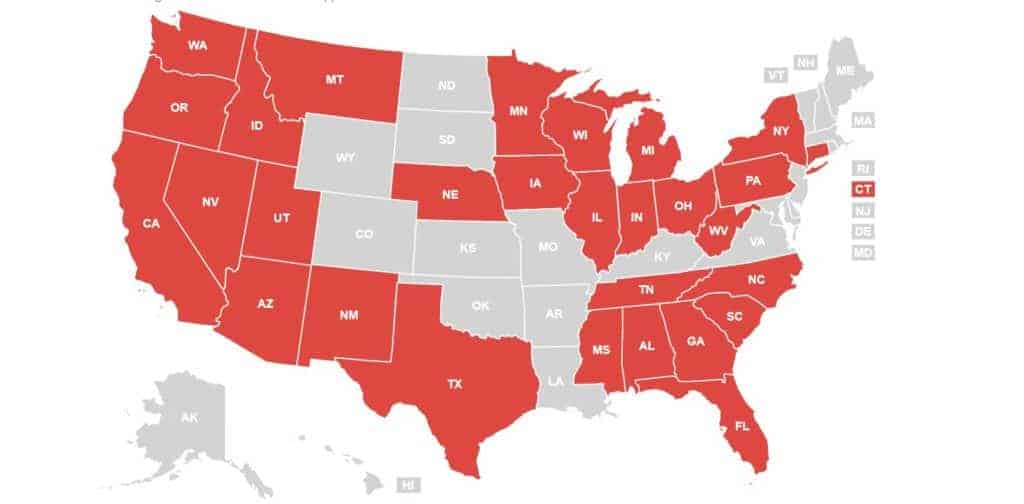
As mentioned earlier, Frontier internet is available in 38 states, including Michigan, Connecticut, North Carolina, Indiana, and West Virginia. If you live in the midwest, you may be out of luck, though.
That said, when it comes to performance, Frontier delivers. According to the FCC’s eighth report, if you grab one of their FiOS plans most people will receive the speeds advertised the majority of the time – during both non-busy and congested usage hours.
Netflix’s July 2019 ISP Leaderboard – which tests internet service providers “prime time Netflix performance” – ranked Frontier in 10th place overall. But don’t let that worry you – Frontier’s DSL service took 2nd place of the major DSL providers; and Frontier’s FiOS took 3rd place among major fiber-optic internet providers (above competitor CenturyLink).
Frontier Customer Service
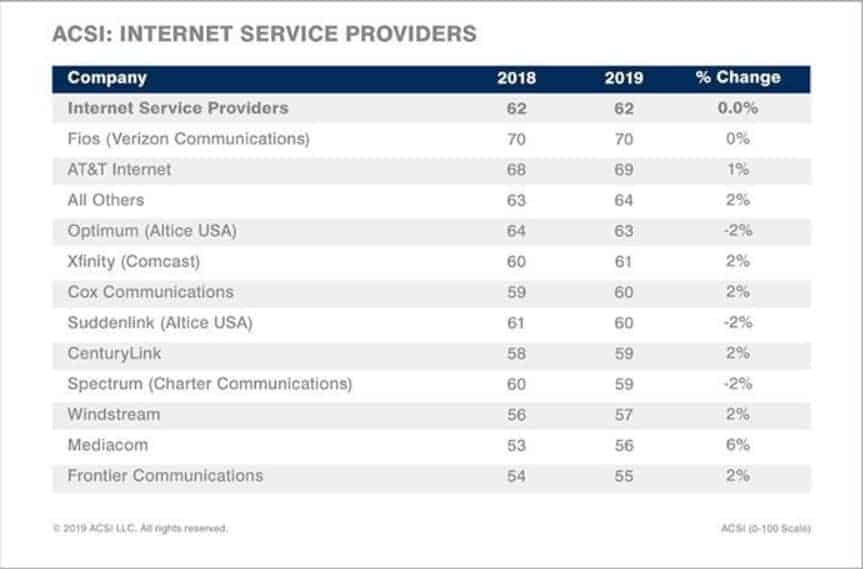
As with most ISPs, Frontier customers are not too happy. A customer even once called them the “worst company on the planet.” Thankfully, that’s an old review.
But even so, while others like AT&T or Verizon Fios lead the pack, Frontier is all the way at the bottom. Although they improved their ACSI score by 1 point since 2018, they’re still deadlast.
Their online support center, however, isn’t bad, with basic FAQ-style answers to common questions. If you need to get ahold of a real person, you’ve got phone or internet chat options:
- Phone: 1-888-993-1870
- Chat
- Support page
Recap
The bottom line is that Frontier Internet is the best option for those who live in more rural areas where bigger providers like AT&T or Xfinity can’t reach. If the ISPs available to you are satellite – HughesNet and Viasat – dialup, and Frontier – go with Frontier. You’ll get better speeds and lower latency than with either satellite internet option.
Otherwise, there are a few reasons to pick them over others:
- Zero data caps
- 12-month price lock
- No contract options (Except FiOS plans)
- Wider rural availability
But you may get better prices, potentially faster speeds, and better customer service if other ISPs like AT&T, Spectrum, or Xfinity is around.
Q&A
Is Frontier Internet good for gaming?
Yes. Frontier’s fiber-optic plans are especially good due their speeds. The 200/200 plan is a good mix of value-for-cost, but if you play a lot of games or other members of your home do as well, you’ll want to opt for one of the higher-speed fiber tiers to ensure everyone has enough bandwidth.
What if my Frontier router needs to be upgraded?
Per Frontier’s website, router upgrades are included in your service fee. You may receive a notice that requires you to upgrade your router’s firmware – the stuff that makes it work. The notice should include steps to do that, but in case not, it should look similar to this one.
Are there any hidden fees with Frontier?
Taxes aren’t included, but vary by state. Otherwise, fees are laid out pretty well: $10 a month for the router, and between $40 and $75 for installation (or $9.99 for self-install). There’s also an “internet infrastructure surcharge” (about $3.99/mo).