
 Luke Pensworth
AT&T is one of the most well-recognized brands in the world, let alone the U.S., and it stands as one of the Big 4 carriers alongside the likes of Verizon, T-Mobile, and Sprint. However, while Verizon and T-Mobile battle for the top spot on the performance rankings chart, AT&T focuses on quietly putting in an all-around good performance of their own.
The carrier has consistently come in 2nd or 3rd place, depending on the study you look at– although in fact, the largest mobile performance study ever done ranked AT&T the #1 overall best national wireless network. In any case, whether you look at that study, OpenSignal’s yearly report, or RootMetrics’, scoring for AT&T has consistently ranked them as one of the best for coverage, reliability, and speed.
But how do AT&T’s plans stand up for consumers? Who are their plans best for? And who are they not so good for? Let’s find out.
AT&T Plans + Pricing
| Plans | Data | Price | View Plans |
|---|---|---|---|
| AT&T Unlimited &More | Unlimited* | $70/mo.** | View plans |
| AT&T Unlimited &More Premium | Unlimited* + 15GB hotspot | $80/mo.** | View plans |
| Mobile Share Plus 3GB | 3GB 4G LTE* | $50/mo.** | View plans |
| Mobile Share Plus 9GB | 9GB 4G LTE* | $60/mo.** | View plans |
| Prepaid 1GB | 1GB 4G LTE* | $35/mo.** | View plans |
| Prepaid 8GB | 8GB 4G LTE* | $40/mo.** | View plans |
| Prepaid Unlimited | Unlimited* | $55/mo.** | View plans |
| Prepaid Unlimited | Unlimited* + 10GB Hotspot | $75/mo. | View plans |
*4G LTE speeds are slowed to max of 128Kbps once limit is reached.
**Price includes autopay and paperless billing discount.
Compared to the other Big 4, AT&T was a latecomer to the unlimited data game; until only recently, AT&T offered unlimited plans only to those who bundled with their cable TV service: DirecTV (and they haven’t owned them for that long). But, AT&T now offers 2 unlimited plans, alongside 2 family plans (“Shared Plus”), and a host of prepaid plans ranging in data size from 1GB to unlimited.
Unlimited Plans
| Plans | Price | Data | Features | View Plans |
|---|---|---|---|---|
| AT&T Unlimited &More | $70/mo.** | Unlimited* |
|
View plans |
| AT&T Unlimited &More Premium | $80/mo.** | Unlimited* + 15GB hotspot |
|
View plans |
*4G LTE speeds are slowed to max of 128Kbps once limit is reached.
**Price includes autopay and paperless billing discount.
All of AT&T’s plans feature unlimited talk and text — regardless of whether you have prepaid or unlimited. But AT&T’s Unlimited & More and Unlimited & More Premium both feature access to WatchTV, a streaming service that gives you 35+ channels.
Premium gets better, with HD-quality video (1080p), plus a 15GB hotspot data allowance, and your choice of one entertainment streaming platform: HBO, ShowTime, Amazon Music, Pandora, VRV, and more– at no extra charge (that’s worth about $10 or $15 extra by itself depending on the service; in other words, it pays for itself if it’s a single line).
In comparison, the previous plan– &More– caps streaming at 480p and has no hotspot data allowance, although you can still tether. Unlimited &More also reserves the right to throttle you during busy periods, while &More Premium doesn’t start throttling you until you reach 22GB of 4G LTE data used.
But both of those deprioritization thresholds are the same as Verizon’s (22GB) and lower than both Sprint and T-Mobile.
If you use more than 22GB of data each month, consider T-Mobile: their soft data caps range from 32GB-50GB per month.
That said, &More winds up being a better value for the family: $160/mo. vs. $190/mo. for 4 lines.
| Plans | 1 line | 2 lines | 3 lines | 4 lines |
|---|---|---|---|---|
| Unlimited &More | $70/mo. | $125/mo. ($63/line) | $145/mo. ($49/line) | $160/mo. ($40/line) |
| Unlimited &More Premium | $80/mo. | $150/mo. ($75/line) | $170/mo. ($57/line) | $190/mo. ($48/line) |
Shared Plus
| Plans | Price | Features |
|---|---|---|
| Mobile Share Plus 3GB | $50/mo.** |
|
| Mobile Share Plus 9GB | $60/mo.** |
|
*4G LTE speeds are slowed to max of 128Kbps once limit is reached.
**Price includes autopay and paperless billing discount.
Speaking of family lines, AT&T offers their “Mobile Shared Plus” plans as family plans. With the Shared Plus plans, you share your data among up to 4 people, making it best for families where not everyone needs much data. That said, it’s a better family plan than either Verizon or Sprint — Verizon offers 8GB for $75 a month and Sprint just 2GB for $45.
If you need data, though, you can get discounts for adding lines to AT&T’s regular plans.
Prepaid plans
| Plans | Price | Features | View Plans |
|---|---|---|---|
| Prepaid 1GB | $35/mo.** |
|
View plans |
| Prepaid 8GB | $40/mo.** |
|
View plans |
| Prepaid Unlimited | $55/mo.** |
|
View plans |
| Prepaid Unlimited | $75/mo. |
|
View plans |
*4G LTE speeds are slowed to max of 128Kbps once limit is reached.
**Price includes autopay and paperless billing discount.
If AT&T still isn’t floating your boat, they offer some pretty compelling prepaid options, too. Of those, the 8GB plan probably has the best value at $40-50 per month; but there are also 2 unlimited prepaid options, as well. These have the same rules as the regular unlimited plans: the 1st-tier one can get throttled at any time; the 2nd-tier doesn’t get throttled until 22GB, plus you get 10GB hotspot and 1080p HD video.
If you want multiple lines for your family, you get escalating discounts with the prepaid plans, too: $10 off the 2nd and 3rd lines, and $20 off the 4th.
International plans
What about international options? AT&T offers a few options: Roaming in North America, and an International Day Pass.
| Plans | Price | Features |
|---|---|---|
| Roaming in North America |
Included in:
|
|
| International Day pass | $10/24 hours |
|
*4G LTE speeds are slowed to max of 128Kbps once limit is reached.
**Price includes autopay and paperless billing discount.
The Day Pass is $10 per day, so that can get expensive, but might just be a necessary expense if you travel a lot. The Roaming In North America is pretty awesome assuming you have one of the Unlimited plans (since it is included with them by default) and actually have family, friends, or anybody else you want to talk to that lives in Canada or Mexico.
Car Hotspot Plan
What about international options? AT&T offers a few options: Roaming in North America, and an International Day Pass.
| Plans | Price | Features |
|---|---|---|
| Car hotspot | $20/mo.* |
|
*Eligible vehicle and wireless service required.
**Up to 22GB; after you may experience slower speeds.
AT&T does something unique here: a data plan for your car. AT&T Connected Car turns your vehicle into a mobile hotspot, making it a fantastic option for families who go on road trips often. It’ll cost you just $20 a month for unlimited data on the road with the same 22GB threshold.
Fees + overage charges
AT&T doesn’t have any data overage charges– just that throttling once you pass your data limit. They do have a $45 activation fee per phone– including if you bring your own– which is a bit iffy. Verizon charges just $30 for activation per line, and Sprint and T-Mobile have gotten rid of activation fees entirely.
AT&T is currently running a promotion for BYOP: they’ll waive the fee when you bring your own phone. Just do so before 5/30/19
| Brands | Sample models |
|---|---|
| Apple | iPhone XR, iPhone XS, XS Max, iPhone X, iPhone 8, 8 Plus, etc. |
| Samsung | Samsung Galaxy S10, S10 + 128GB, S10 + 512GB, S10e, Galaxy Note9, S9, etc. |
| LG | G8ThinQ, Stylo 4+, K30, G6 Duo, etc. |
AT&T doesn’t lack in choices unless you want an ancient flip phone– in that case, you may be out of luck. But does AT&T have the Applie iPhone X, Samsung Galaxy S10E, and the ZTE Axon M? Yes, yes, and yes. You’ll find the latest brands at AT&T– no problem.
Although Google Pixel can’t be bought directly through AT&T (Verizon still has that monopolized), you can purchase a Google phone unlocked and bring it over. But while Verizon controls direct sales of Google phones, AT&T boasts a few “gets” of its own — like the BlackBerry KeyOne… Look, I didn’t say those gets were impressive. That’s why it was in quotation marks. (Okay, it’s not that bad.)
If you want to bring your phone over from your current carrier, check out AT&T’s compatibility check to make sure it’ll crossover. It’ll have to be a GSM unlocked phone, not CDMA.
Coverage + Performance
AT&T doesn’t have any data overage charges– just that throttling once you pass your data limit. They do have a $45 activation fee per phone– including if you bring your own– which is a bit iffy. Verizon charges just $30 for activation per line, and Sprint and T-Mobile have gotten rid of activation fees entirely.
AT&T is currently running a promotion for BYOP: they’ll waive the fee when you bring your own phone. Just do so before 5/30/19
Cell phones + Devices
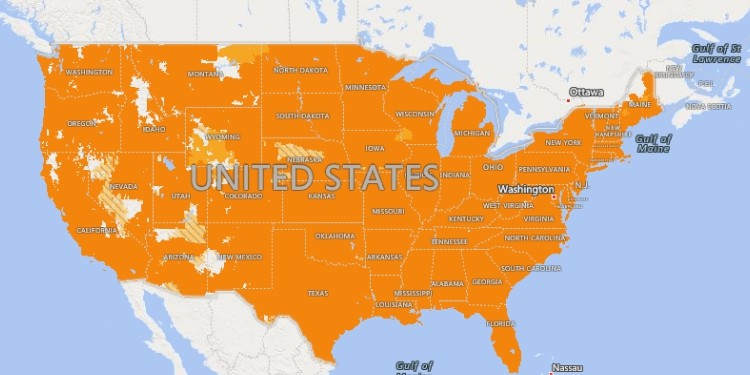
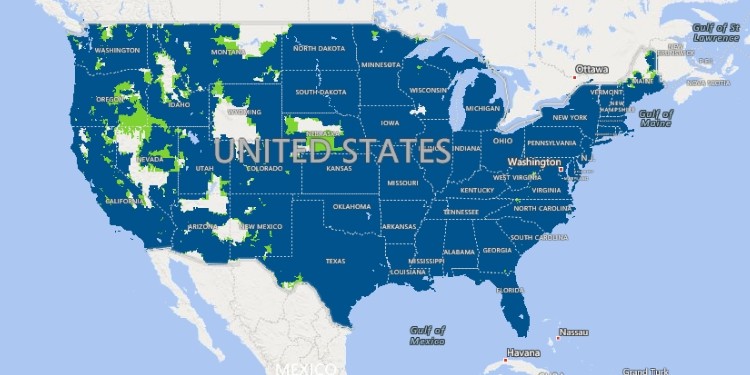
Voice coverage, left; Data coverage, right.
When it comes to AT&T, they don’t score the highest numbers for speed overall in traditionally-referenced studies– but they do score the best latency scores according to OpenSignal; in other words, AT&T has the least amount of “lag” on their network, and texting delivery speeds and reliability are great.
But while rankings like Rootmetrics showed AT&T in 2nd-place behind Verizon, other studies have said differently. America’s biggest mobile network test actually found AT&T to be the fastest network in the nation– placing above even Verizon and T-Mobile– and, more recently, Ookla declared the same. The latter showed an improvement of 15% in speeds in just January-March of 2019, while other carriers plateaued.
Our verdict is that you get greater-than-solid coverage that’s very reliable– but, check the regions important to you before you switch.
Customer service
AT&T’s customer service used to be pretty good, as far as carriers go, but then they switched to a new automated phone-tree system, which sometimes routes people to the wrong department. That aside, problems primarily arise in clarity of customers’ bills.
But even with those things, AT&T has a lot of good things going for their customer support department:
- Online help is extensive
- Phone reps (when you reach them) are knowledgeable
- Facebook and Twitter accounts provide basic, if delayed, answers
AT&T offers a variety of ways to get ahold of their customer service:
- Phone – 611 from AT&T mobile number; 800-331-0500 otherwise
- Live chat
- Community forums
- Twitter- @ATTCares
Recap-- How good are AT&T’s phone plans?
If you want to save money on TV subscriptions, AT&T’s unlimited plans are the ones to choose. Of those two, Premium is the only way to get 1080p HD video, a guarantee of no throttling until 22GB, and extra mobile hotspot data– so go with that one.
If you don’t care about TV, go with one of their prepaid plans– they’re cheaper, with only minor losses in features.
When it comes to coverage, AT&T falls just behind the most widespread, reliable carrier– Verizon– but not by much (although, naturally, what matters most is the coverage where you live). This makes AT&T a great choice for people who don’t live in or spend much time in the country. If you live in a larger metro or the surrounding area, you might get better value from T-Mobile or Sprint, who work great in those kinds of regions.
Depending on the rankings you look at, AT&T is either the fastest carrier, or at least close to the top. In either case, your texts will send fast and if you play games on your smartphone, you won’t experience much delay, if any.
Good for most people, best for TV fans looking to save money by bundling with DIRECTV, NOW, or AT&T U-Verse.
FAQs
Can I bring my tablet over to AT&T? Do they have data plans for that?
Yes. AT&T offers both a Brint-Your-Own-Phone (BYOP) plan, as well as a Bring-Your-Own-Device (BYOD) plan. If your tablet or other wireless device has 4G capabilities, you can get the AT&T DataConnect plan, which gives you 250MB, 3GB, or 5GB, for $14.99/mo., $30/mo., or $50/mo., respectively.
Be aware that these plans do have overage charges on them, though: $14.99/250MB on that plan, and $10/1GB on the other plans.
What is AT&T WatchTV?
WatchTV is AT&T’s streaming app. It gives you 35 live channels, including ones like HGTV, Cartoon Network, and AMC. It also includes thousands of on-demand titles. There’s no contract, and you can cancel anytime.
What discounts does AT&T offer?
AT&T actually offers several discounts:
Autopay + Paperless Billing
If you’ve been paying attention, you’d have seen the double asterisks next to most of the prices in our above tables that mention this.
You’ll get $10 off your monthly bill when you sign up for autopay and paperless billing– this is the price that AT&T offers for each plan. If you elect not to, you’ll pay $10 more per month than advertised for single lines, and $20 more per month for multiple lines.
Military Discount
All qualified active military personnel and veterans save an extra 15% on their monthly bill.
DirecTV Bundling
AT&T also offers $15 off each month’s bill when you bundle your phone plan with DIRECTV or DIRECTV Now.